Reset My Airbag

reset my airbag

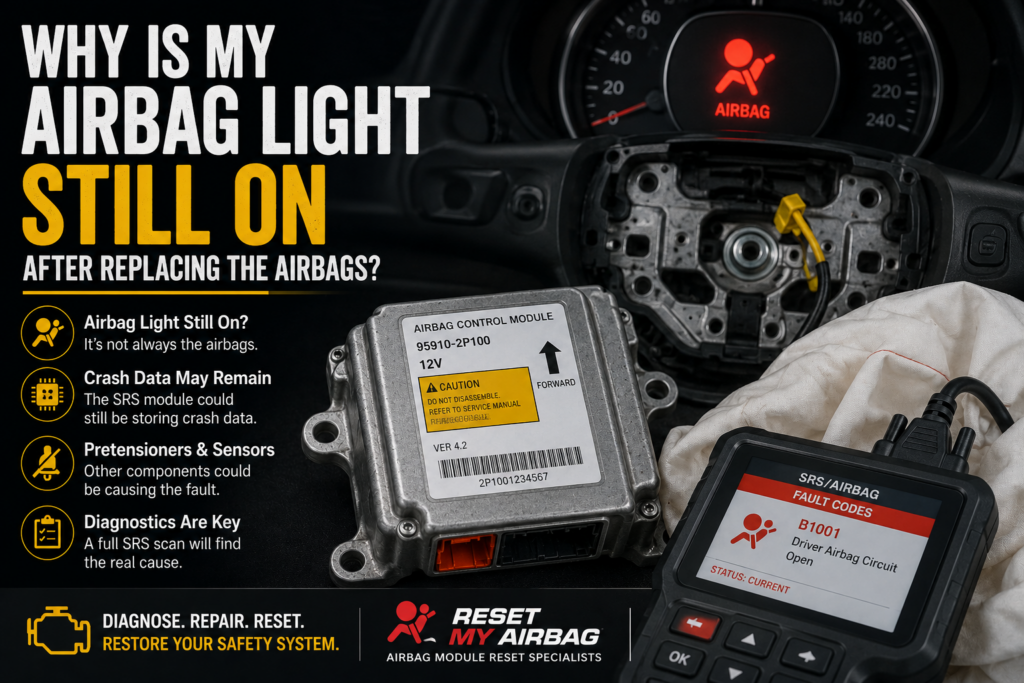
Why Is My Airbag Light Still On After Replacing the Airbags?

Why Is My Airbag Light Still On After Replacing the Airbags?

You’ve replaced the deployed airbags after an accident, switched the ignition back on and expected the airbag warning light to disappear.

But it’s still there.

So, why is your airbag light still on after replacing the airbags?

The short answer is that replacing deployed airbags does not necessarily reset the entire Supplementary Restraint System (SRS).

After a collision, other components may also require attention. The vehicle’s airbag control module may contain stored crash data, seat belt pretensioners may have activated, sensors may be damaged, or the SRS system may have additional stored faults.

In many cases, simply installing replacement airbags is only one part of the complete accident repair process.

If the airbag warning light remains illuminated, the vehicle should be professionally diagnosed to identify the exact cause.

This guide explains the most common reasons an SRS warning light remains on after airbag replacement and when an airbag module crash data reset may be required.


Quick Answer: Why Is the Airbag Light Still On After Replacing the Airbags?

If your airbag light remains on after replacing deployed airbags, the SRS system may still have an active or stored fault.

Possible causes include:

  • Crash data stored in the airbag control module
  • Activated seat belt pretensioners
  • Additional deployed or faulty SRS components
  • Damaged impact sensors
  • Wiring or connector faults
  • Incorrectly fitted replacement components
  • An incompatible replacement airbag
  • A faulty steering wheel clock spring
  • An airbag control module fault
  • Components that require coding or calibration
  • Diagnostic fault codes that remain after repairs

Replacing an airbag does not automatically resolve these other issues.

The vehicle’s SRS system should be scanned using suitable diagnostic equipment to identify any remaining fault codes.


What Happens to the SRS System When Airbags Deploy?

During a collision, the vehicle’s Supplementary Restraint System can react within milliseconds.

Depending on the type and severity of the impact, the system may activate one or more safety components.

These can include:

  • Driver airbag
  • Passenger airbag
  • Side airbags
  • Curtain airbags
  • Knee airbags
  • Seat belt pretensioners
  • Other restraint devices

The airbag control module, also known as the SRS module or airbag ECU, plays a central role within this system.

The module receives information from sensors and other components and may record information relating to a collision or deployment event.

This information is commonly referred to as crash data.

After the accident, replacing the deployed airbags does not necessarily remove crash data stored within the airbag control module.

As a result, further work may be required before the SRS system can return to normal operation.


1. The Airbag Control Module Still Contains Crash Data

One of the reasons an airbag warning light may remain on following accident repairs is stored crash data within the airbag control module.

When a collision occurs, the SRS control unit may record crash or deployment information.

Depending on the vehicle and module, this information may remain stored even after deployed airbags have been replaced.

In some cases, a conventional diagnostic scanner cannot simply erase this data.

The airbag control module may need to be removed from the vehicle and sent to a specialist for an airbag module crash data reset.

If the original module is supported, serviceable and suitable for resetting, the stored crash data may be cleared before the module is returned for refitting.

However, an airbag module reset only addresses the data stored within the module.

It does not repair other faults elsewhere in the SRS system.


2. The Seat Belt Pretensioners Have Activated

Seat belt pretensioners are an important part of many modern vehicle restraint systems.

During certain collisions, the pretensioners may activate to rapidly tighten the seat belt and help restrain the occupant.

Even if you replace all deployed airbags, an activated or faulty seat belt pretensioner can still cause an SRS fault.

Depending on the vehicle and the type of pretensioner, the affected component may require appropriate repair or replacement.

This is one reason the complete restraint system should be inspected following an accident rather than focusing only on visible airbag deployment.


3. There Are Additional SRS Faults

The airbag warning light does not only monitor the airbags themselves.

It can indicate faults involving various components within the Supplementary Restraint System.

Depending on the vehicle, these may include:

  • Airbag circuits
  • Seat belt pretensioners
  • Impact sensors
  • Occupancy sensors
  • Seat position sensors
  • Clock springs
  • SRS wiring
  • Electrical connectors
  • Airbag control module

If any of these components has a fault, the SRS warning light may remain illuminated.

A diagnostic scan can help identify which circuit or component requires further investigation.


4. A Crash Sensor May Be Damaged

Vehicles can use multiple impact or crash sensors as part of the restraint system.

Depending on the location and severity of the accident, one or more sensors may have been damaged.

The wiring or electrical connections associated with these sensors may also have been affected.

If the SRS module detects a sensor-related fault, the warning light may remain on even after the deployed airbags have been replaced.

The affected sensor and associated circuits should be correctly diagnosed rather than automatically replacing parts based only on a fault code.


5. There Is a Wiring or Connector Problem

Accident damage can affect wiring and connectors throughout the vehicle.

SRS wiring may be located in areas including:

  • Behind the dashboard
  • Under the front seats
  • Inside the steering wheel
  • Around seat belt assemblies
  • Near crash sensors
  • Behind interior trim

During accident repairs, components and interior panels may be removed and refitted.

A damaged wire, loose connection or incorrectly fitted connector can potentially cause an SRS fault.

Because airbag systems include safety-critical and pyrotechnic components, SRS wiring should be inspected and repaired using appropriate procedures.


6. The Replacement Airbag Is Not Compatible

Using an incorrect or incompatible replacement component can potentially result in an SRS fault.

Even when an airbag appears physically similar, differences can exist between:

  • Vehicle models
  • Model years
  • Trim levels
  • Airbag systems
  • Part numbers
  • Electrical characteristics

Replacement SRS components should be appropriate for the specific vehicle.

If the airbag warning light appeared after installing replacement components, verify that the correct parts have been fitted.


7. The Airbag Control Module Has an Internal Fault

Stored crash data and an internally faulty airbag control module are not necessarily the same problem.

In some cases, the module itself may have suffered physical damage, electrical failure or another internal fault.

A crash data reset may not resolve an internally defective module.

The unit may require specialist assessment to determine whether it is suitable for resetting, repair or replacement.


8. A Replacement Module May Need Coding or Configuration

Some vehicle owners choose to replace the original airbag control module with a new or used unit.

Depending on the vehicle, a replacement module may require:

  • Coding
  • Programming
  • Configuration
  • Calibration
  • Vehicle-specific setup

A used module may also contain data or configuration from the donor vehicle.

For this reason, replacing an SRS control unit is not always a simple plug-and-play solution.

Where appropriate, resetting the vehicle’s original module may avoid some compatibility issues associated with fitting a replacement unit.

The correct procedure depends on the vehicle manufacturer and module.


9. Fault Codes Have Not Been Cleared

After repairing the underlying problem, some diagnostic fault codes may need to be cleared using suitable diagnostic equipment.

However, there is an important distinction between clearing a diagnostic fault code and resetting stored crash data.

A diagnostic scanner may be able to erase certain fault codes once the underlying problem has been resolved.

Crash or deployment data stored within the airbag control module may require specialist procedures.

If you clear the codes and the warning light immediately returns, there is likely to be an active fault that still requires investigation.


How Do I Find Out Why My Airbag Light Is Still On?

The best starting point is a complete diagnostic scan of the SRS system.

Step 1: Scan the Airbag/SRS Control System

Use suitable diagnostic equipment capable of communicating with the vehicle’s SRS module.

A basic engine code reader may not provide full access to the airbag system.

Record the fault codes before clearing anything.

Step 2: Check the Accident Repair History

Identify which components activated or were damaged during the collision.

Confirm which parts have already been replaced or repaired.

This could include:

  • Driver airbag
  • Passenger airbag
  • Curtain airbags
  • Side airbags
  • Seat belt pretensioners
  • Crash sensors
  • Airbag control module

Step 3: Investigate Active Fault Codes

Each fault code should be correctly diagnosed.

Do not assume that replacing the component named in a diagnostic code will automatically solve the problem.

Wiring and electrical connections may also need to be checked.

Step 4: Determine Whether Crash Data Is Stored

If the diagnostic results indicate crash or deployment data within the SRS control module, the module may require specialist attention.

Depending on the vehicle and module, it may be possible to professionally reset the original airbag control unit.

Step 5: Repair All Remaining SRS Faults

Any deployed, activated, damaged or faulty components should be addressed according to appropriate repair procedures.

Step 6: Clear Codes and Recheck the System

Once all repairs have been completed, the SRS system should be scanned again.

Any appropriate diagnostic codes can then be cleared and the system checked to confirm that no active faults remain.


Can I Clear the Airbag Light With an OBD2 Scanner?

Not always.

Basic OBD2 scanners often focus primarily on engine and emissions-related diagnostic information.

To diagnose an airbag warning light, you generally need equipment capable of communicating with the vehicle’s SRS control system.

Even with suitable diagnostic equipment, some stored crash data may not be removable through the vehicle’s diagnostic port.

A specialist airbag module reset may be required.

It is also important to remember that clearing a warning light without repairing the underlying fault does not fix the SRS system.

If an active fault remains, the warning light is likely to return.


Will Disconnecting the Battery Reset the Airbag Light After an Accident?

Disconnecting the battery will not normally remove permanently stored crash data from an airbag control module.

It also does not repair:

  • Deployed airbags
  • Activated seat belt pretensioners
  • Damaged sensors
  • Faulty wiring
  • Defective SRS components

If the airbag warning light remains on after accident repairs, proper diagnosis is required.


Do I Need to Reset the Airbag Module After Replacing the Airbags?

Possibly.

If the airbag control module has stored crash data following the accident, the module may require professional resetting.

However, this depends on the specific vehicle and control module.

Not every airbag warning light after an accident is caused by stored crash data.

Before sending a module for resetting, it is helpful to obtain the SRS diagnostic fault codes.

These codes can provide valuable information about remaining faults within the system.


Can the Original Airbag Module Be Reused After a Crash?

In many cases, an original airbag control module may potentially be reused if it is suitable for professional resetting and has not suffered damage or an internal electronic failure.

One potential benefit of retaining the original module is that it is already associated with the vehicle.

However, whether a module can be safely reset and reused depends on the specific unit and vehicle manufacturer requirements.

A specialist should assess the module before determining the appropriate solution.


Is an Airbag Light an MOT Failure in the UK?

Under the UK MOT inspection rules for cars and passenger vehicles, an SRS malfunction indicator lamp indicating a system malfunction is categorised as a Major defect.

This means a vehicle with an SRS warning lamp indicating a system malfunction will not pass its MOT with that defect present.

A passenger airbag warning lamp showing that the passenger airbag has been intentionally disabled is treated differently and is not itself regarded as an SRS system defect.

If your airbag warning light remains on following accident repairs, it is advisable to have the system correctly diagnosed before presenting the vehicle for an MOT.


Airbags Replaced but the SRS Light Is Still On? We May Be Able to Help

If you’ve replaced the airbags following an accident but the SRS warning light is still illuminated, your airbag control module may contain stored crash data.

Reset My Airbag provides specialist airbag module crash data reset services for customers across the UK.

Our service is suitable for supported modules that require crash data resetting following an accident or deployment event.

We work with:

  • Private vehicle owners
  • Garages
  • Mechanics
  • Bodyshops
  • Accident repair centres
  • Vehicle rebuilders

Depending on your vehicle and module, you may be able to remove your original airbag control unit and send it to us for assessment and professional resetting.

Once the module is returned and correctly refitted, the complete SRS system should be professionally diagnosed to confirm that no other faults remain.

Need Your Airbag Module Reset?

Contact Reset My Airbag with:

  • Vehicle make
  • Vehicle model
  • Year
  • Airbag module part number
  • Details of which airbags deployed
  • Details of any activated seat belt pretensioners
  • SRS diagnostic fault codes, if available

We can help determine whether your airbag control module is suitable for our reset service.


Frequently Asked Questions

Why is my airbag light still on after replacing the airbags?

Replacing deployed airbags does not necessarily resolve every SRS fault caused by an accident. The airbag control module may contain stored crash data, seat belt pretensioners may have activated, or there may be additional sensor, wiring or component faults.

Does the airbag module need resetting after airbags deploy?

In some vehicles, the airbag control module may store crash or deployment data following an accident. If the module is suitable, a specialist may be able to reset this data. Other damaged SRS components must still be repaired or replaced separately.

Can I reset the airbag light with a diagnostic scanner?

Some SRS fault codes can be cleared with suitable diagnostic equipment after the underlying fault has been repaired. However, stored crash data may require specialist airbag module resetting.

Why does my airbag light come back after I clear it?

If the warning returns, the vehicle may still have an active SRS fault. The underlying cause should be diagnosed rather than repeatedly clearing the code.

Do seat belt pretensioners need replacing after an accident?

Seat belt pretensioners can activate during certain collisions. If a pretensioner has activated or is faulty, it will require appropriate professional attention according to the vehicle and component involved.

Can I use a second-hand airbag module?

A used airbag module may not necessarily be a direct plug-and-play replacement. Depending on the vehicle, it may require coding, programming or configuration and could contain information from the donor vehicle.

Will disconnecting the battery erase airbag crash data?

Normally, disconnecting the battery will not erase crash data stored within the airbag control module.

Will my car pass an MOT if the airbag light is still on?

If the SRS malfunction indicator lamp is indicating a system malfunction, this is categorised as a Major defect under the UK MOT inspection rules for cars and passenger vehicles.


Final Answer: Why Is the Airbag Light Still On After Airbag Replacement?

If your airbag warning light remains on after replacing deployed airbags, it means the complete SRS repair may not yet be finished or the system still has a stored or active fault.

The cause could be stored crash data within the airbag control module, activated seat belt pretensioners, damaged sensors, wiring faults, incompatible replacement components or another SRS system problem.

The correct approach is to scan the vehicle’s SRS system, identify all remaining fault codes and repair each underlying issue.

If the airbag control module contains stored crash data, a specialist airbag module reset may be required.

For supported modules, Reset My Airbag can assess your original SRS control unit and determine whether it is suitable for professional crash data resetting.

Contact us with your vehicle details, module part number and diagnostic fault codes to find out more.

Leave a Comment

Your email address will not be published. Required fields are marked *